When the Dream Collab Becomes a Creative Cage
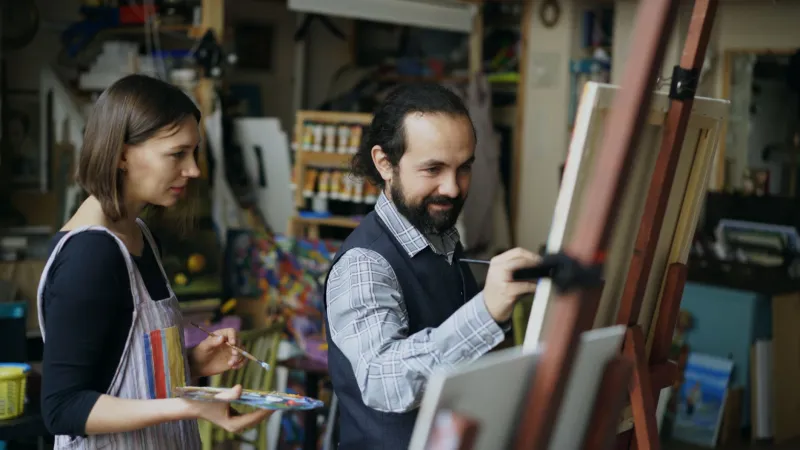
You've been chasing this moment for years. The email finally lands. The studio session gets booked. The mentor says yes. And for a hot second, it feels like everything you ever wanted is clicking into place.
Then something strange happens.
You start second-guessing your instincts. You catch yourself mimicking their cadence, their aesthetic choices, their way of moving through a room. You're not doing it on purpose — it just kind of happens. And slowly, the work you produce in that sacred creative proximity starts to look a whole lot more like them than like you.
Welcome to the collaboration paradox. It doesn't get talked about enough, and honestly, that silence is doing a lot of damage.
The Gravity Problem
When you deeply admire someone's creative output, you're not just a fan — you've been in a long-term relationship with their aesthetic. You've studied how they compose a shot, how they structure a sentence, how they build tension before a release. That intimacy is what makes their work feel meaningful to you.
But it also means you've spent years essentially training yourself to think the way they think.
Now put yourself in the same room as that person, with real stakes on the table, and their creative gravity becomes almost impossible to resist. You want to impress them. You want to speak their language. You want to belong in that space. And without even realizing it, you start orbiting their vision instead of building your own.
This isn't weakness. It's actually a sign that you've been paying attention. But it's also a trap.
Real Talk: Artists Who Had to Walk Away
There's a reason so many musicians talk about their "difficult second album" arriving right after they broke away from a major producer or collaborator they'd been leaning on. The pattern shows up constantly.
Think about how many visual artists describe their most derivative work as the stuff they made during their mentorships — not before them. The mentor's presence, however generous, created a kind of creative shorthand that felt like freedom but was actually a borrowed framework.
Joni Mitchell talked openly about needing to sever certain musical relationships to stop making music that sounded like what she thought other people wanted from her. Jean-Michel Basquiat's early street work had a rawness that some critics argue got smoothed out during his high-profile collaborations with Andy Warhol — not because Warhol was a bad influence, but because Warhol's sheer cultural weight changed what Basquiat thought was possible or appropriate for him to make.
This isn't about blaming the collaborator. It's about acknowledging that creative influence is a two-way gravitational pull, and the person with more mass usually wins.
Why We Don't Talk About This
The creative industry — especially in the US — has a serious hustle-culture problem around networking and collaboration. We're conditioned to treat every high-profile connection as a pure win. Getting into a room with someone established is framed as the goal, full stop.
There's almost no cultural language for saying: that collaboration hurt my work, and I needed to step back.
And there's definitely no language for saying it without sounding ungrateful. So artists stay quiet. They rationalize. They tell themselves the imitation phase is temporary, that they'll find their voice again on the other side.
Sometimes they do. But sometimes they don't — because by the time they realize what's happened, their audience has already come to expect the borrowed aesthetic, and pivoting back to something more authentically their own feels like a risk they can't afford.
Holding Your Ground Without Burning the Bridge
So what do you actually do when you're in the middle of a dream collaboration and you start feeling your edges blur?
Keep a private creative practice running in parallel. Not for public consumption, not for the collaboration — just for you. Sketches, voice memos, journal entries, rough cuts. This is where your actual instincts live when they're not performing for someone you respect. Protect that space aggressively.
Name the influence out loud. There's something weirdly powerful about saying to yourself — or even to your collaborator — "I notice I'm gravitating toward your approach here, and I want to make sure I'm also bringing something that's distinctly mine." It makes the dynamic conscious instead of invisible. Conscious dynamics are manageable. Invisible ones eat you alive.
Set creative boundaries before the project starts. This is the part nobody does because it feels awkward. But knowing in advance which elements of the work are non-negotiable expressions of your own vision — and communicating that clearly — changes everything. It's not about being difficult. It's about showing up as a full creative collaborator rather than a very enthusiastic assistant.
Build in a decompression period. After any high-intensity creative collaboration, give yourself a chunk of time — weeks, ideally — to make work that has nothing to do with that project. No shared language, no borrowed framework. Just you, figuring out what you actually think again.
The Difference Between Influence and Infiltration
Here's the thing: influence is supposed to happen. You're supposed to absorb things from the people you work with. That's how creative evolution works. The goal isn't to emerge from every collaboration unchanged — that would actually be a failure of engagement.
The question is whether the influence is expanding your vocabulary or replacing it.
Expansion looks like: you learned a new technique, a different way of approaching structure, a perspective you hadn't considered — and now you can integrate that into your own evolving practice.
Replacement looks like: you stopped trusting your original instincts because someone else's instincts seemed more validated, more sophisticated, more worth following.
One of those makes you a more interesting artist. The other makes you a very good approximation of someone else.
Admiration Is Not the Same as Alignment
You can love someone's work without your work needing to look like theirs. In fact, the most generative creative relationships tend to be ones where both people are genuinely different — where the friction between two distinct visions produces something neither could have made alone.
That only happens if both people actually show up as themselves.
The artists who navigate this best are the ones who go into high-profile collaborations already deeply anchored in their own practice — not because they're arrogant, but because they've done the work of knowing what they actually think, feel, and want to make. They're excited by their hero's vision without being destabilized by it.
That kind of groundedness isn't something you can fake. It has to be built before the room gets crowded.
So the real prep work for your dream collaboration? It's not perfecting your portfolio or learning their process. It's getting so clear on who you are as a maker that even the most powerful creative gravity in the room can't pull you off course.
Do that first. Then take the meeting.