Stop Watching How They Work: The Process-Envy Spiral That's Quietly Wrecking Your Creativity

There's a particular kind of paralysis that hits around 11pm when you've spent two hours watching studio vlogs, behind-the-scenes reels, and "my creative process" breakdowns from artists you admire. You close your laptop feeling simultaneously inspired and completely hollowed out. You know more about how someone else makes their work than you know about how you make yours. That's not inspiration. That's a slow-motion takeover.
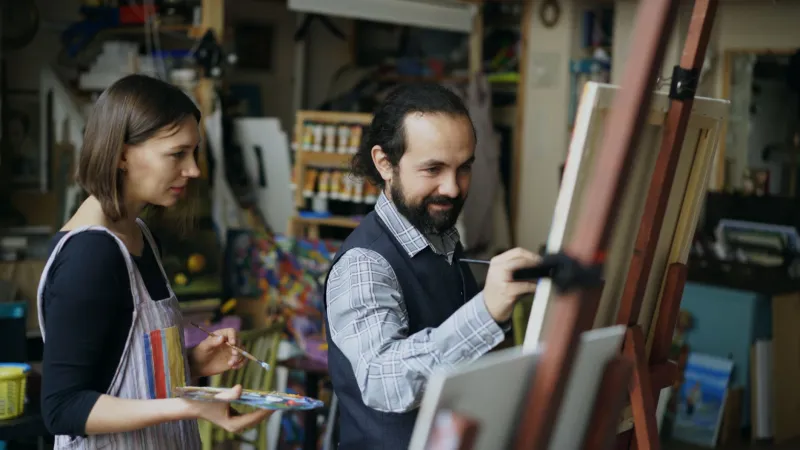
We live in a moment where documenting the process has become almost as important as the work itself. Artists share morning routines, sketchbook tours, playlist selections, the exact brand of tape they use to mount their references. None of that is inherently bad. But somewhere along the way, watching became a substitute for doing — and worse, it started making a lot of us feel like our own instincts were fundamentally broken.
When Inspiration Becomes a Blueprint You Never Asked For
Here's the thing nobody talks about when they tell you to "study the greats": there's a massive difference between understanding someone's influences and quietly adopting their entire operating system. The first one feeds you. The second one quietly replaces you.
When you watch enough process content, patterns start to feel like rules. You notice that a painter you love always starts with a tonal study, so you start doing tonal studies even though you've always worked straight from color and it's always felt right. A musician you follow swears by writing in 90-minute blocks with no phone, so you trash your own loose, wandering approach — the one that's actually produced your best stuff — because it doesn't look disciplined enough compared to theirs.
You're not adopting a technique. You're importing someone else's nervous system and wondering why it doesn't fit.
The deeper problem is that process content is almost always told backward. Artists document what worked after it worked. They present a cleaned-up, coherent narrative of how they arrived at something great, when in reality the actual path was chaotic, accidental, and full of abandoned dead ends that didn't make the final edit. You're comparing your real, messy, in-progress process to someone else's highlight reel of a process. That comparison is rigged from the start.
The Methodology Mimic Problem
There's a version of this that gets even more specific and more insidious: methodology mimicry. This is when you don't just adopt someone's general vibe, but you actually start replicating the structural architecture of how they work. Their time blocks, their tools, their organizational systems, their creative rituals.
Some of that is fine. Trying things is how you figure out what fits. But there's a line between experimenting with a new approach and wholesale outsourcing your creative identity to someone whose work you admire. When you cross that line, you're not building a practice — you're building a replica of someone else's practice and hoping the outputs will somehow be your own.
The uncomfortable truth is that methodology mimicry often comes from a place of not trusting yourself. If their process produced that work, maybe their process will produce good work from me too. It feels logical. It is not. Creative process is deeply personal, weirdly biological, tied up in your specific history and your specific set of anxieties and your specific way of moving through the world. There's no universal formula, and the moment you find yourself convinced there is one, you've already started drifting away from the thing that makes your work worth making.
What Actually Happens When You Stop Looking
A lot of artists who step back from heavy process consumption report the same thing: an initial period of real discomfort followed by something that feels a lot like relief. Without a constant stream of other people's methods to measure against, you're forced back into your own instincts. And your instincts, it turns out, have been trying to tell you something the whole time.
You might find that your "bad" habits were actually your habits — the specific, idiosyncratic ways you work that produce results you couldn't have predicted. The weird hour you naturally hit your stride. The unconventional order you approach things in. The fact that you need music with lyrics when everyone says you shouldn't. These aren't flaws to be corrected. They're data points about who you actually are as a creative person.
Building a practice that's authentically yours means being willing to look a little chaotic from the outside. It means resisting the urge to aestheticize your workflow for an audience that may or may not exist. It means letting your process be unglamorous, inconsistent, and completely yours.
Practical Ways to Break the Comparison Loop
Do a process fast. Give yourself two weeks where you don't consume any creative process content. No studio tours, no workflow breakdowns, no "day in the life" videos from artists you follow. Just work. Notice what happens when you're not measuring your approach against anyone else's.
Start documenting your own process first. Before you watch anyone else's, write down how you actually work right now. Not how you want to work, not how you think you should work — how you actually do it. That document becomes your baseline. It makes it easier to notice when you're drifting toward someone else's system.
Ask why before you adopt anything new. When you come across a technique or approach that intrigues you, pause before you implement it. Ask yourself: am I drawn to this because it genuinely addresses something I'm struggling with, or am I drawn to it because it looks like the kind of thing a serious artist would do? One of those is useful. The other is cosplay.
Let your outputs be the teacher. Instead of studying how other people work, study your own work. Look at the pieces you're most proud of and trace back what you actually did to make them. That's your process data. That's the methodology that's already proven itself in your specific context.
Consume outcomes, not methods. There's nothing wrong with deeply engaging with finished work — looking at a painting, listening to an album, watching a film — and trying to understand what's working and why. That's different from watching someone explain their morning routine. Engage with the work, not the workflow.
Your Process Isn't Supposed to Look Like Theirs
The comparison trap is particularly brutal for creative people because it operates under the cover of self-improvement. You're not procrastinating, you're researching. You're not avoiding your work, you're learning from the best. It has the texture of productivity while quietly eating the time and confidence you need to actually make things.
Here's the reframe that might actually help: your process being different isn't a problem to solve. It's the whole point. The specific, personal, slightly-weird way you work is what makes your work yours. The goal isn't to find the right method — it's to find your method, which will probably look nothing like anyone else's and work perfectly anyway.
Stop watching. Start working. Your process is already in there, waiting for you to stop comparing it to death.